import numpy as np
import matplotlib.pyplot as plt
import pyleoclim as pyleo
from climatecritters.utils.resample import downsampleDownsampling — Simulating Sparse Proxy Records
Abstract
resample.downsample sub-samples a regularly spaced model trajectory to simulate the irregular sampling of paleoclimate proxy records. This notebook demonstrates four gap-distribution modes — exponential, Poisson, Pareto, and random_choice — and shows how to inspect the resulting resolution statistics using pyleoclim’s resolution dashboard.
Keywords
downsample, sub-sampling, proxy records, sparse sampling, exponential, Poisson, Pareto, random_choice, resolution, pyleoclim
series = pyleo.utils.load_dataset('SOI').interp()
print(f'n={len(series.time)}  dt={series.time[1]-series.time[0]:.3f} yr  '
      f'span={series.time[0]:.1f}–{series.time[-1]:.1f} yr')
n=1909 dt=0.083 yr span=1866.0–2025.0 yr
{'archiveType': 'Instrumental', 'label': 'Southern Oscillation Index'}Original series and resolution
fig, ax = series.plot()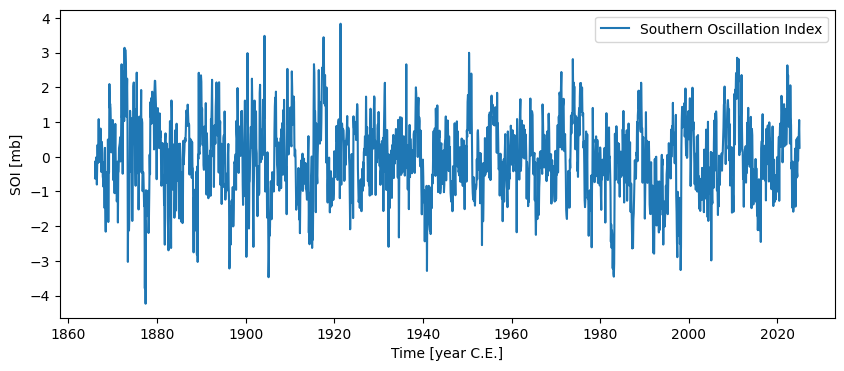
{'archiveType': 'Instrumental', 'label': 'Southern Oscillation Index'}series.resolution().dashboard()(<Figure size 1100x800 with 2 Axes>,
{'res': <Axes: xlabel='Time [year C.E.]', ylabel='resolution [year C.E.]'>,
'res_hist': <Axes: xlabel='Counts'>})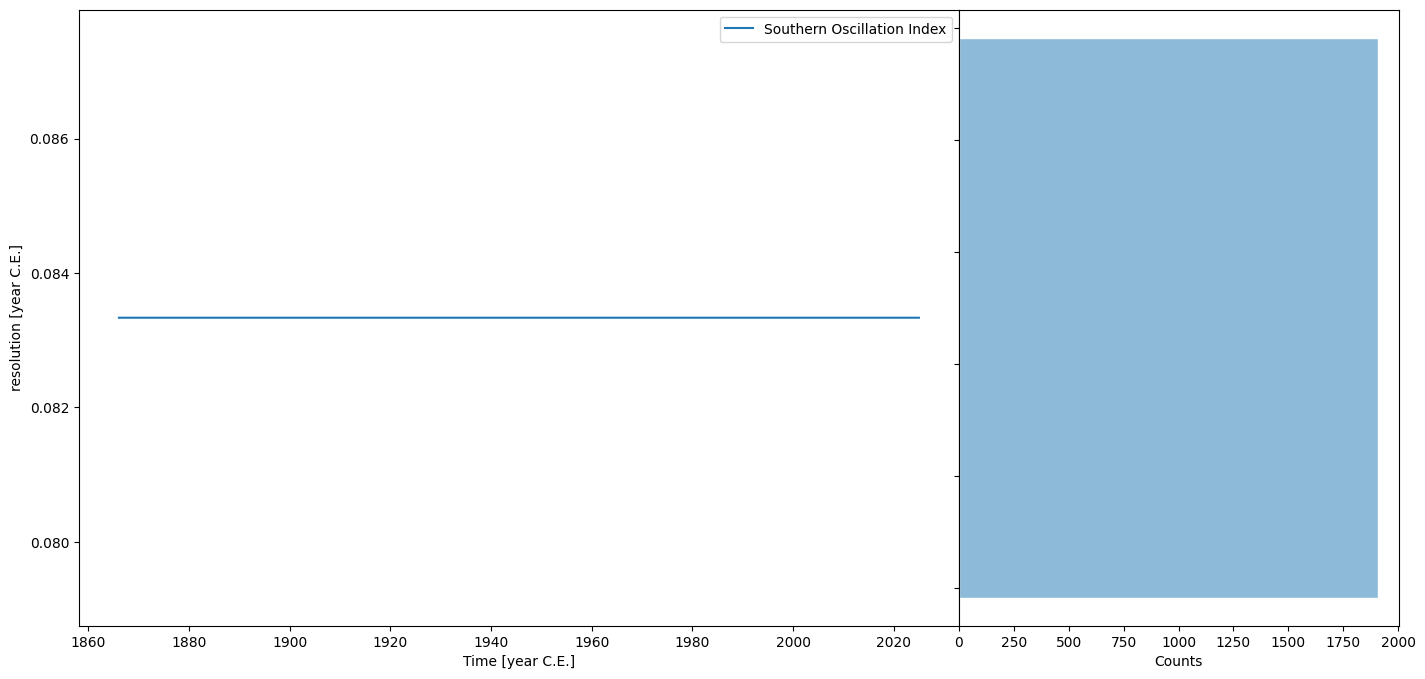
{'archiveType': 'Instrumental', 'label': 'Southern Oscillation Index'}Exponential
method='exponential', param=[scale]
Index gaps ~ Exponential(scale). Scale = mean gap size. Heavy right tail: most gaps are small, occasional large ones — like bioturbated marine records.
ds_exp = downsample(series, method='exponential', param=[2], seed=42){'archiveType': 'Instrumental', 'label': 'Southern Oscillation Index'}
{'archiveType': 'Instrumental', 'label': 'Southern Oscillation Index'}fig, ax = plt.subplots(figsize=(11, 3))
ax.plot(series.time, series.value,
color='#888888', lw=1.0, alpha=0.6, label='original')
ax.plot(ds_exp.time, ds_exp.value,
color='#2196F3', lw=1.5, alpha=0.9, label='downsampled')
ax.set_ylabel('SOI'); ax.legend(fontsize=9)
plt.tight_layout(); plt.show()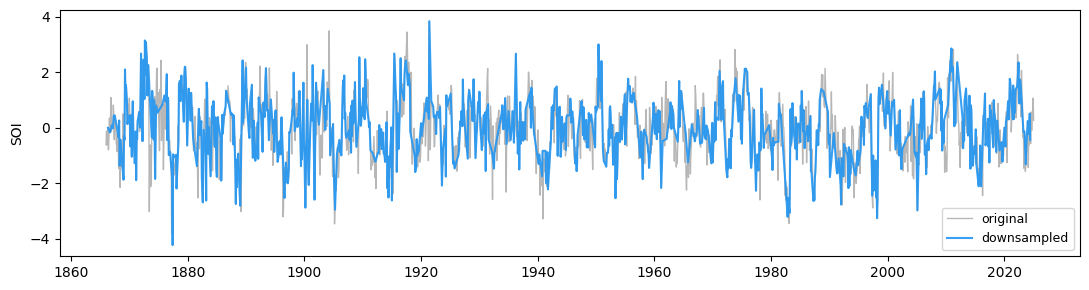
{'archiveType': 'Instrumental', 'label': 'Southern Oscillation Index'}
{'archiveType': 'Instrumental', 'label': 'Southern Oscillation Index'}Figure. The sparse record (blue) keeps exact values at selected indices. Compare coverage and gap structure to the original (gray).
ds_exp.resolution().dashboard()(<Figure size 1100x800 with 2 Axes>,
{'res': <Axes: xlabel='Time [year C.E.]', ylabel='resolution [year C.E.]'>,
'res_hist': <Axes: xlabel='Counts'>})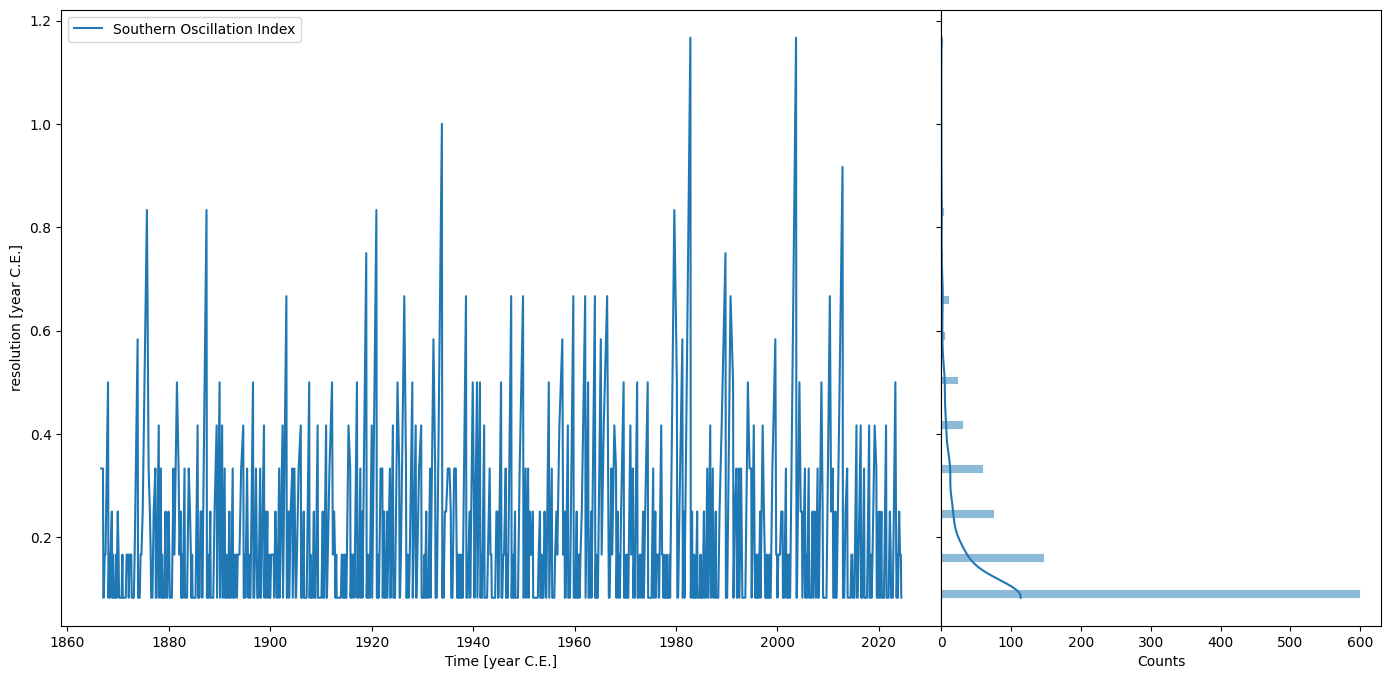
{'archiveType': 'Instrumental', 'label': 'Southern Oscillation Index'}
{'archiveType': 'Instrumental', 'label': 'Southern Oscillation Index'}Poisson
method='poisson', param=[rate]
Gaps ~ Poisson(rate) + 1. More symmetric around the mean — fewer extreme long gaps than Exponential.
ds_poi = downsample(series, method='poisson', param=[3], seed=42){'archiveType': 'Instrumental', 'label': 'Southern Oscillation Index'}
{'archiveType': 'Instrumental', 'label': 'Southern Oscillation Index'}
{'archiveType': 'Instrumental', 'label': 'Southern Oscillation Index'}fig, ax = plt.subplots(figsize=(11, 3))
ax.plot(series.time, series.value,
color='#888888', lw=1.0, alpha=0.6, label='original')
ax.plot(ds_poi.time, ds_poi.value,
color='#E91E63', lw=1.5, alpha=0.9, label='downsampled')
ax.set_ylabel('SOI'); ax.legend(fontsize=9)
plt.tight_layout(); plt.show()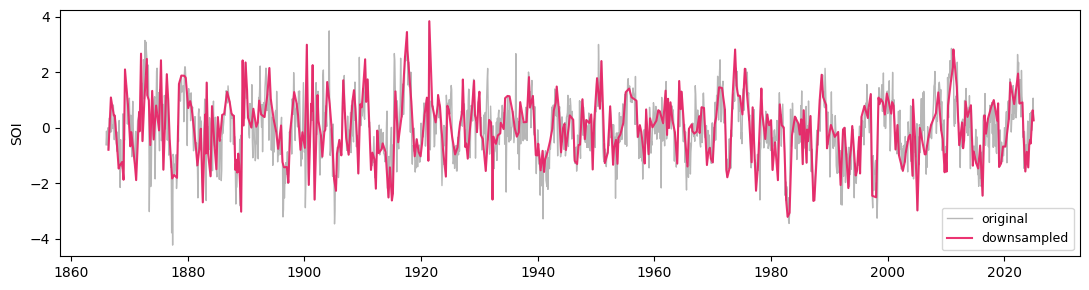
{'archiveType': 'Instrumental', 'label': 'Southern Oscillation Index'}
{'archiveType': 'Instrumental', 'label': 'Southern Oscillation Index'}
{'archiveType': 'Instrumental', 'label': 'Southern Oscillation Index'}Figure. Tighter gap distribution: coverage is more uniform than Exponential, fewer long stretches without a sample.
ds_poi.resolution().dashboard()(<Figure size 1100x800 with 2 Axes>,
{'res': <Axes: xlabel='Time [year C.E.]', ylabel='resolution [year C.E.]'>,
'res_hist': <Axes: xlabel='Counts'>})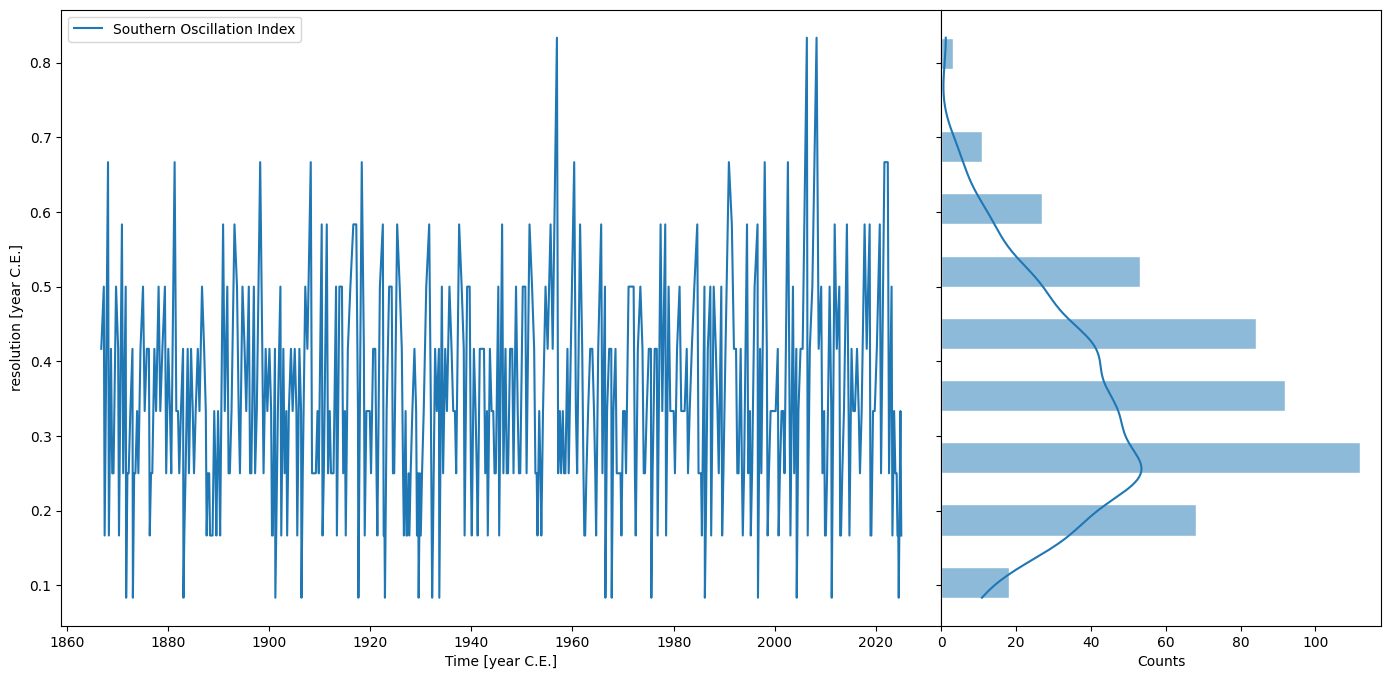
{'archiveType': 'Instrumental', 'label': 'Southern Oscillation Index'}
{'archiveType': 'Instrumental', 'label': 'Southern Oscillation Index'}
{'archiveType': 'Instrumental', 'label': 'Southern Oscillation Index'}Pareto
method='pareto', param=[shape, scale]
Gaps ~ (Pareto(shape) + 1) × scale. Power-law tail: small shape → very heavy tail with occasional extremely long hiatuses. Mimics patchy carbonate preservation.
ds_par = downsample(series, method='pareto', param=[2, 1], seed=42){'archiveType': 'Instrumental', 'label': 'Southern Oscillation Index'}
{'archiveType': 'Instrumental', 'label': 'Southern Oscillation Index'}
{'archiveType': 'Instrumental', 'label': 'Southern Oscillation Index'}
{'archiveType': 'Instrumental', 'label': 'Southern Oscillation Index'}fig, ax = plt.subplots(figsize=(11, 3))
ax.plot(series.time, series.value,
color='#888888', lw=1.0, alpha=0.6, label='original')
ax.plot(ds_par.time, ds_par.value,
color='#4CAF50', lw=1.5, alpha=0.9, label='downsampled')
ax.set_ylabel('SOI'); ax.legend(fontsize=9)
plt.tight_layout(); plt.show()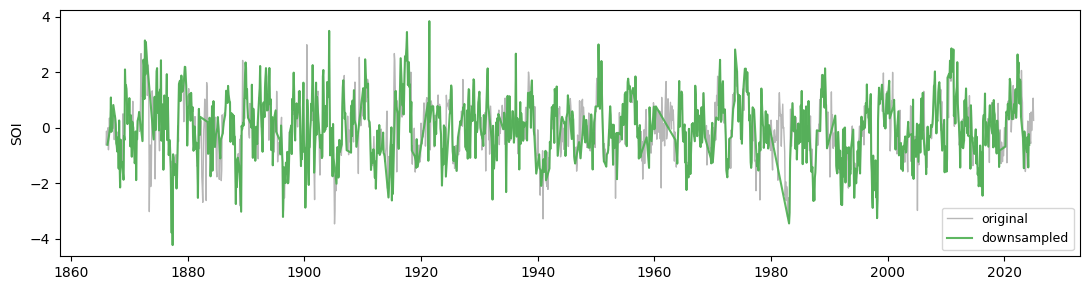
{'archiveType': 'Instrumental', 'label': 'Southern Oscillation Index'}
{'archiveType': 'Instrumental', 'label': 'Southern Oscillation Index'}
{'archiveType': 'Instrumental', 'label': 'Southern Oscillation Index'}
{'archiveType': 'Instrumental', 'label': 'Southern Oscillation Index'}Figure. Rare but very long gaps dominate the resolution dashboard — the heavy tail means the record can go silent for extended periods.
ds_par.resolution().dashboard()(<Figure size 1100x800 with 2 Axes>,
{'res': <Axes: xlabel='Time [year C.E.]', ylabel='resolution [year C.E.]'>,
'res_hist': <Axes: xlabel='Counts'>})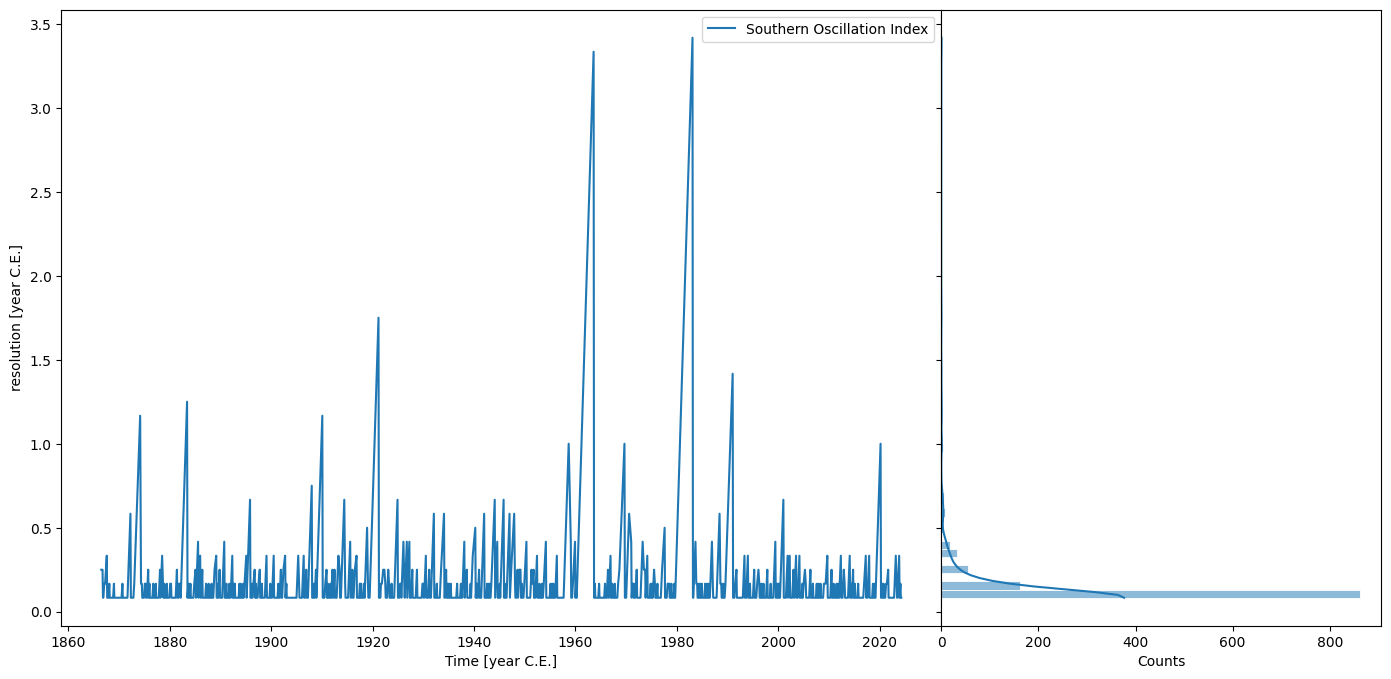
{'archiveType': 'Instrumental', 'label': 'Southern Oscillation Index'}
{'archiveType': 'Instrumental', 'label': 'Southern Oscillation Index'}
{'archiveType': 'Instrumental', 'label': 'Southern Oscillation Index'}
{'archiveType': 'Instrumental', 'label': 'Southern Oscillation Index'}Random choice
method='random_choice', param=[[values], [probabilities]]
Gaps drawn from a discrete distribution. Use when you know the sampling process — e.g. annual cores with occasional multi-year losses.
ds_rc = downsample(series, method='random_choice',
param=[[1, 5, 20], [0.80, 0.15, 0.05]], seed=42){'archiveType': 'Instrumental', 'label': 'Southern Oscillation Index'}
{'archiveType': 'Instrumental', 'label': 'Southern Oscillation Index'}
{'archiveType': 'Instrumental', 'label': 'Southern Oscillation Index'}
{'archiveType': 'Instrumental', 'label': 'Southern Oscillation Index'}
{'archiveType': 'Instrumental', 'label': 'Southern Oscillation Index'}fig, ax = plt.subplots(figsize=(11, 3))
ax.plot(series.time, series.value,
color='#888888', lw=1.0, alpha=0.6, label='original')
ax.plot(ds_rc.time, ds_rc.value,
color='#9C27B0', lw=1.5, alpha=0.9, label='downsampled')
ax.set_ylabel('SOI'); ax.legend(fontsize=9)
plt.tight_layout(); plt.show()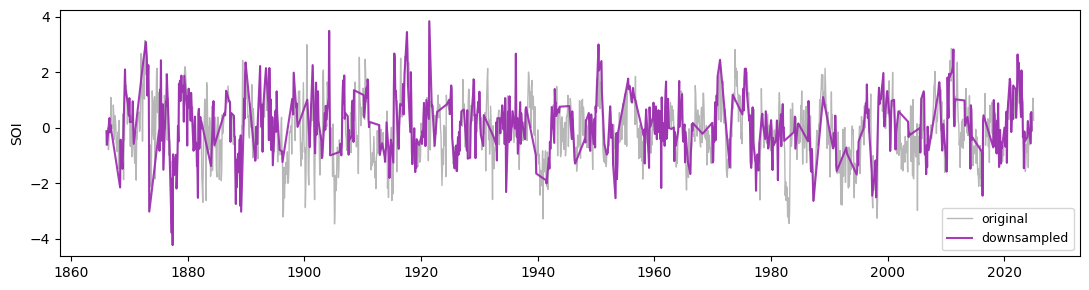
{'archiveType': 'Instrumental', 'label': 'Southern Oscillation Index'}
{'archiveType': 'Instrumental', 'label': 'Southern Oscillation Index'}
{'archiveType': 'Instrumental', 'label': 'Southern Oscillation Index'}
{'archiveType': 'Instrumental', 'label': 'Southern Oscillation Index'}
{'archiveType': 'Instrumental', 'label': 'Southern Oscillation Index'}Figure. Three distinct gap sizes visible in the resolution dashboard, at the specified probabilities (80 % × 1, 15 % × 5, 5 % × 20).
ds_rc.resolution().dashboard()(<Figure size 1100x800 with 2 Axes>,
{'res': <Axes: xlabel='Time [year C.E.]', ylabel='resolution [year C.E.]'>,
'res_hist': <Axes: xlabel='Counts'>})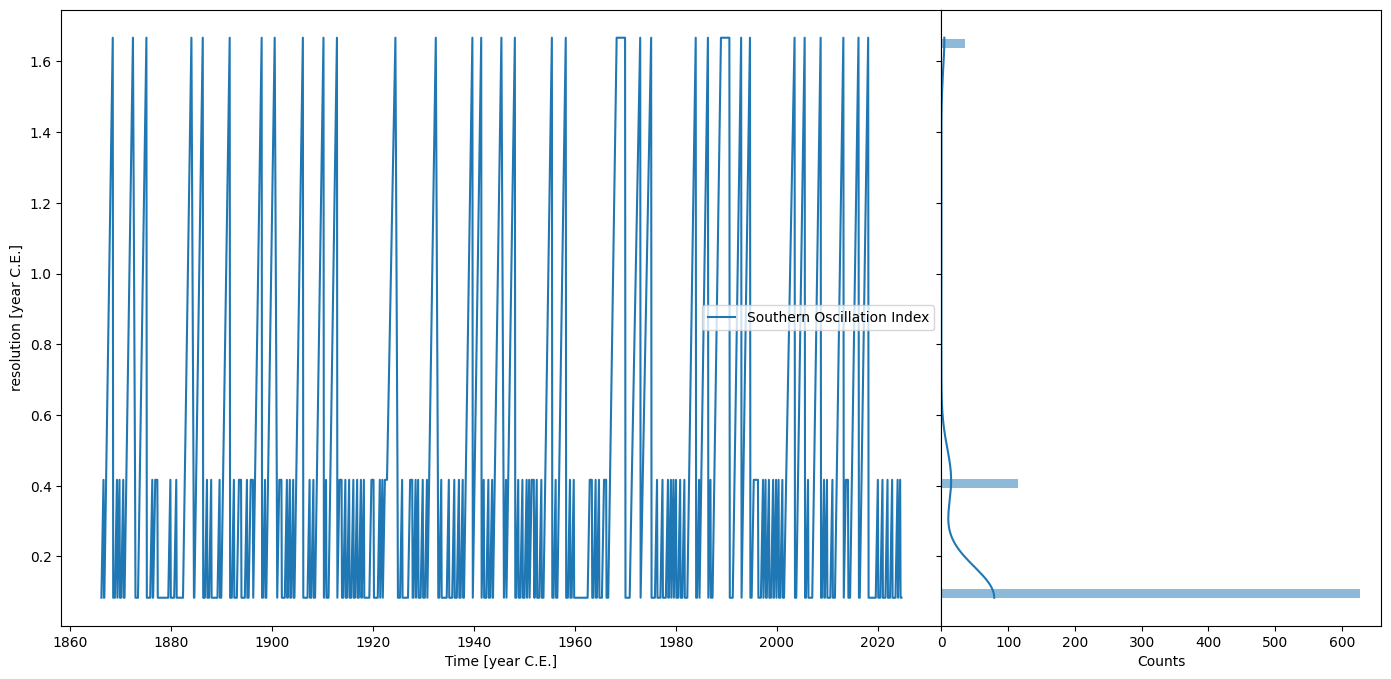
{'archiveType': 'Instrumental', 'label': 'Southern Oscillation Index'}
{'archiveType': 'Instrumental', 'label': 'Southern Oscillation Index'}
{'archiveType': 'Instrumental', 'label': 'Southern Oscillation Index'}
{'archiveType': 'Instrumental', 'label': 'Southern Oscillation Index'}
{'archiveType': 'Instrumental', 'label': 'Southern Oscillation Index'}Method comparison — gap-size histograms
labels = ['Exponential(2)', 'Poisson(3)', 'Pareto(2,1)', 'RC(1/5/20)']
dss = [ds_exp, ds_poi, ds_par, ds_rc]
colours = ['#2196F3', '#E91E63', '#4CAF50', '#9C27B0']
fig, axes = plt.subplots(1, 4, figsize=(14, 4), sharey=True)
for ax, ds, lbl, col in zip(axes, dss, labels, colours):
gaps = np.diff(ds.time)
ax.hist(gaps, bins=30, color=col, alpha=0.7, edgecolor='none')
ax.axvline(gaps.mean(), color='k', lw=1.2, ls='--',
label=f'mean={gaps.mean():.2f}')
ax.set_title(lbl, fontsize=9); ax.set_xlabel('Δt'); ax.legend(fontsize=7)
axes[0].set_ylabel('count')
fig.suptitle('Gap-size histograms for all four methods')
plt.tight_layout(); plt.show()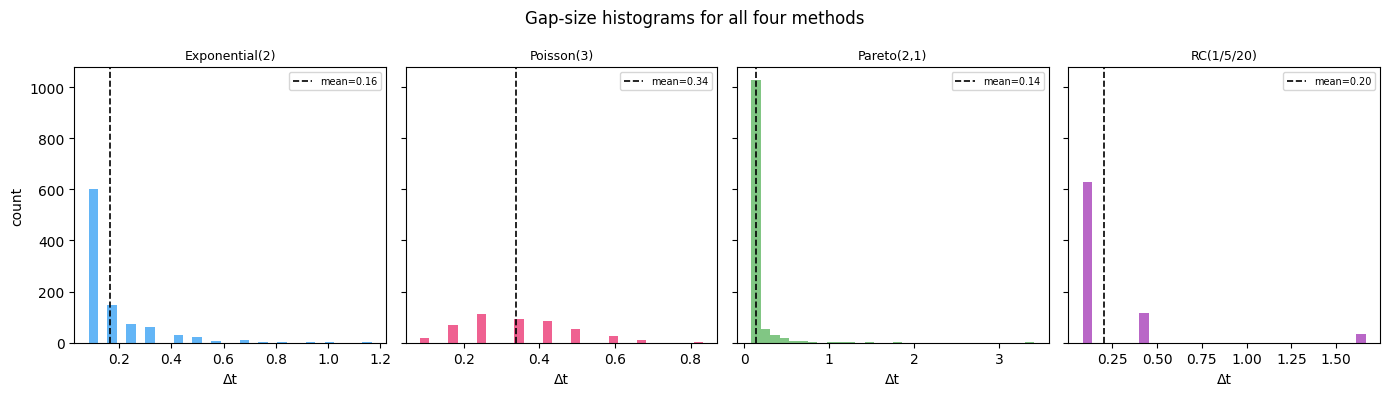
{'archiveType': 'Instrumental', 'label': 'Southern Oscillation Index'}
{'archiveType': 'Instrumental', 'label': 'Southern Oscillation Index'}
{'archiveType': 'Instrumental', 'label': 'Southern Oscillation Index'}
{'archiveType': 'Instrumental', 'label': 'Southern Oscillation Index'}
{'archiveType': 'Instrumental', 'label': 'Southern Oscillation Index'}
{'archiveType': 'Instrumental', 'label': 'Southern Oscillation Index'}
{'archiveType': 'Instrumental', 'label': 'Southern Oscillation Index'}
{'archiveType': 'Instrumental', 'label': 'Southern Oscillation Index'}
{'archiveType': 'Instrumental', 'label': 'Southern Oscillation Index'}
{'archiveType': 'Instrumental', 'label': 'Southern Oscillation Index'}Figure. Exponential: mode near zero, exponential decay. Poisson: symmetric around the mean. Pareto: heavy right tail. Random choice: discrete spikes at the specified values. Choose the distribution that matches your sampling process.