import numpy as np
import matplotlib.pyplot as plt
import climatecritters as cc
from climatecritters.model_critters.stommel import Stommel

model = Stommel(E=0.3, T_star=1.0, S_star=0.0)
output = model.integrate(t_span=(0, 50), y0=[1.0, 0.0], method='RK45')Stommel — Two-Box Thermohaline Circulation Model
Abstract
Stommel models Atlantic overturning circulation as two boxes — equatorial and polar — exchanging heat and salinity driven by their density contrast. This notebook demonstrates freshwater perturbation via both parameter replacement and state-additive forcing, the bifurcation between thermally-driven and salinity-dominated overturning modes, and time-evolving parameter sweeps.
Keywords
Stommel, thermohaline circulation, AMOC, overturning, freshwater forcing, bistability, salinity-driven mode, density contrast, bifurcation, register_forcing
Overview
The Stommel (1961) model tracks two state variables — the pole-to-equator temperature contrast T and salinity contrast S — and uses them to compute an overturning circulation strength q. Both variables are dimensionless in the default parameter set.
The diagnostic q is the key output: positive values indicate thermally-driven (on) circulation; negative values indicate haline-driven (reversed) circulation.
Equations
\[ q = k(\alpha T - \beta S) \]
\[ \frac{dT}{dt} = -\lambda_T (T - T^*) - |q|\, T \]
\[ \frac{dS}{dt} = E - \lambda_S (S - S^*) - |q|\, S \]
The restoring terms pull T and S toward their equatorial references. The advective terms |q|T and |q|S represent overturning transport. E is a net freshwater flux (evaporation minus precipitation).
Parameters
| Name | Description | Default |
|---|---|---|
alpha |
Thermal expansion coefficient | 1.0 |
beta |
Haline contraction coefficient | 1.0 |
k |
Hydraulic constant (sensitivity of q to density contrast) |
1.0 |
E |
Net evaporation-minus-precipitation freshwater flux | 0.0 |
lambda_T |
Thermal restoring rate | 1.0 |
lambda_S |
Saline restoring rate | 1.0 |
T_star |
Equilibrium temperature contrast | 1.0 |
S_star |
Equilibrium salinity contrast | 0.0 |
All parameters accept a float, a callable (t) / (t, state), or a cc.Forcing object. External forcings are attached after construction via register_forcing — see the Forcing section below.
Basic run
State variables and the overturning diagnostic are accessed directly from the output object:
T = output.state_variables['T']
S = output.state_variables['S']
q = output.diagnostic_variables['q']
time = output.time

fig, axes = plt.subplots(3, 1, figsize=(8, 7), sharex=True)
axes[0].plot(time, T, color='firebrick');  axes[0].set_ylabel('T')
axes[1].plot(time, S, color='steelblue'); axes[1].set_ylabel('S')
axes[2].plot(time, q, color='purple')
axes[2].axhline(0, color='k', lw=0.8, ls='--')
axes[2].set_ylabel('q (overturning)'); axes[2].set_xlabel('time')
fig.suptitle('Stommel — E=0.3'); plt.tight_layout(); plt.show()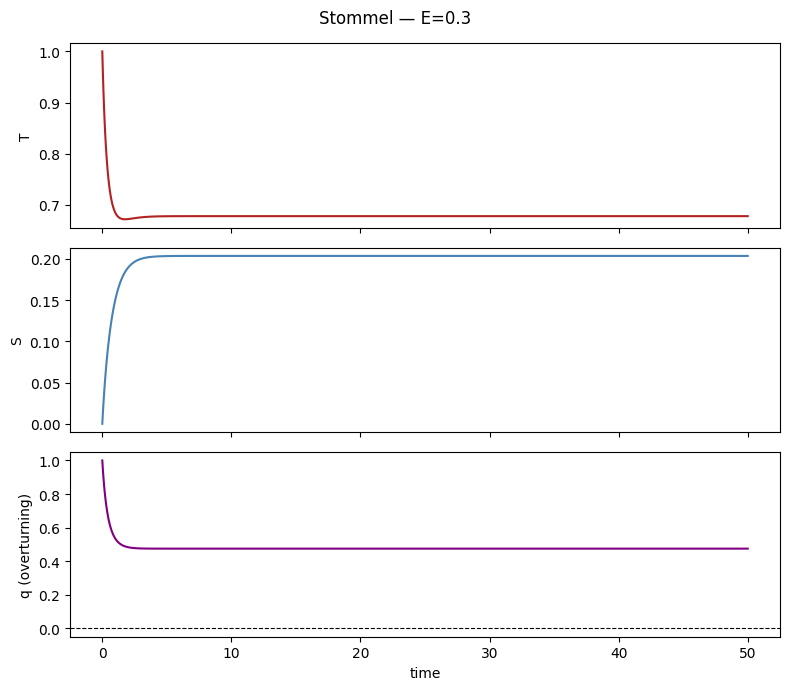
Figure. Default run (\(E=0.3\), \(T^*=1\)). Temperature contrast \(T\) equilibrates quickly (fast restoring). Salinity contrast \(S\) evolves more slowly under the specified freshwater exchange. Overturning \(q\) starts positive (temperature-driven, TH mode) and settles to a steady value — the system remains in the thermally-direct circulation state for these parameters.
Forcing
Forcings are attached after construction using register_forcing. There are two meaningfully different places to attach a freshwater forcing in this model, with different physical interpretations.
First, build the forcing object. cc.Forcing accepts a callable, an array with a time axis, or a sequence of composable Hold, Ramp, and Harmonic elements:
fw_forcing = cc.Forcing.from_sequence([
    cc.forcing.Hold(duration=10, value=0.0),
    cc.forcing.Ramp(duration=5,  y0=0.0, yf=0.5),
    cc.forcing.Hold(duration=15, value=0.5),
    cc.forcing.Ramp(duration=5,  y0=0.5, yf=0.0),
    cc.forcing.Hold(duration=15, value=0.0),
])
Always plot the forcing first so the signal is explicit before running any model:
t_plot = np.linspace(0, 50, 500)
fig, ax = plt.subplots(figsize=(8, 2.5))
ax.plot(t_plot, [fw_forcing.get_forcing(t) for t in t_plot], color='teal')
ax.set_xlabel('time'); ax.set_ylabel('freshwater flux'); ax.set_title('Freshwater pulse forcing')
plt.tight_layout(); plt.show()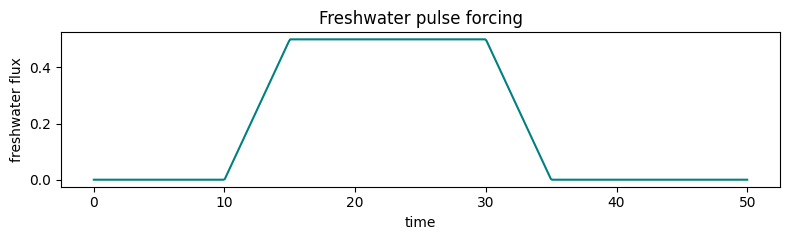
Approach 1: parameter replacement on E
register_forcing('E', forcing_obj) replaces the E parameter entirely with the forcing value at each timestep. This is the natural physical interpretation: the forcing is the freshwater flux. Any value of E set at construction is overridden during integration.
m_E = Stommel(E=0.0, T_star=1.0, S_star=0.0)
m_E.register_forcing('E', fw_forcing)    # attachment_style='replacement', timing='pre' by default
out_E = m_E.integrate(t_span=(0, 50), y0=[1.0, 0.0], method='RK45')
Approach 2: additive forcing on state variable S
register_forcing('S', forcing_obj, 'additive', timing='pre') adds the forcing value to dS/dt inside the right-hand side at each function evaluation. This is a perturbation on top of whatever E is already doing.
m_S = Stommel(E=0.0, T_star=1.0, S_star=0.0)
m_S.register_forcing('S', fw_forcing, 'additive', timing='pre')
out_S = m_S.integrate(t_span=(0, 50), y0=[1.0, 0.0], method='RK45')
Comparing the two approaches
When E=0 at construction, both approaches are mathematically equivalent: replacing E with F(t) gives dS/dt = F(t) - ..., and adding F(t) to dS/dt with E=0 gives the same expression.
t_plot = np.linspace(0, 50, 500)

fig, axes = plt.subplots(3, 1, figsize=(9, 8), sharex=True)

axes[0].plot(t_plot, [fw_forcing.get_forcing(t) for t in t_plot], color='teal')
axes[0].set_ylabel('forcing value'); axes[0].set_title('Applied freshwater signal')

axes[1].plot(out_E.time, out_E.diagnostic_variables['q'],
             color='purple', lw=2, label='E replacement (E=0 base)')
axes[1].plot(out_S.time, out_S.diagnostic_variables['q'],
             color='orange', lw=1.5, ls='--', label='S additive pre (E=0 base)')
axes[1].axhline(0, color='k', lw=0.8, ls=':')
axes[1].set_ylabel('q (overturning)'); axes[1].legend(fontsize=9)

axes[2].plot(out_E.time, out_E.state_variables['S'],
             color='steelblue', lw=2, label='E replacement')
axes[2].plot(out_S.time, out_S.state_variables['S'],
             color='coral', lw=1.5, ls='--', label='S additive pre')
axes[2].set_ylabel('S'); axes[2].set_xlabel('time'); axes[2].legend(fontsize=9)

fig.suptitle('E=0 baseline: both approaches are equivalent', y=1.01)
plt.tight_layout(); plt.show()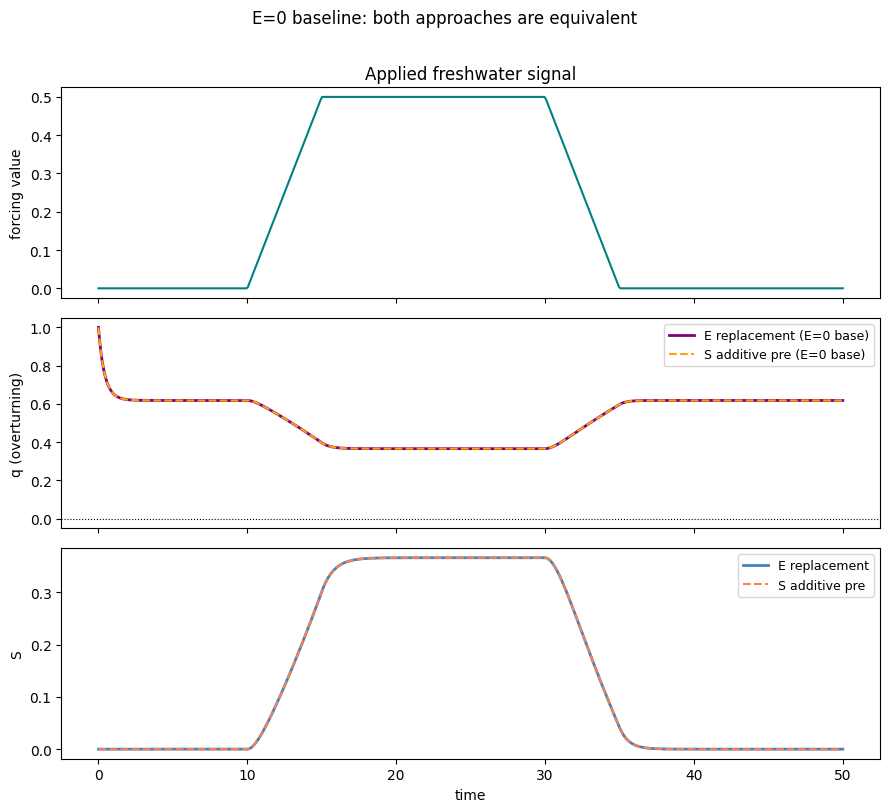
Figure. With \(E=0\) at construction, both forcing approaches are equivalent: the overturning \(q\) traces are indistinguishable (top panel for E-replacement, overlapping dashes for S-additive). The freshwater pulse briefly weakens overturning; the system recovers when the pulse ends. The forcing itself is shown in the top panel for reference.
The distinction matters when there is a non-zero baseline E. Parameter replacement overrides the baseline entirely during the forced period. Additive pre-step superposes the forcing on top of it:
# E=0.3 baseline — replacement overrides it; additive adds on top
m_E_base = Stommel(E=0.3, T_star=1.0, S_star=0.0)
m_E_base.register_forcing('E', fw_forcing)          # E(t) = fw_forcing, ignoring 0.3

m_S_base = Stommel(E=0.3, T_star=1.0, S_star=0.0)
m_S_base.register_forcing('S', fw_forcing, 'additive', timing='pre')  # dS/dt gets +fw_forcing ON TOP of E=0.3

out_E_base = m_E_base.integrate(t_span=(0, 50), y0=[1.0, 0.0], method='RK45')
out_S_base = m_S_base.integrate(t_span=(0, 50), y0=[1.0, 0.0], method='RK45')

fig, ax = plt.subplots(figsize=(8, 4))
ax.plot(output.time,    output.diagnostic_variables['q'],
        color='gray', ls='--', label='unforced (E=0.3)')
ax.plot(out_E_base.time, out_E_base.diagnostic_variables['q'],
        color='purple', label='E replacement (forcing replaces E=0.3)')
ax.plot(out_S_base.time, out_S_base.diagnostic_variables['q'],
        color='orange', label='S additive pre (forcing + E=0.3)')
ax.axhline(0, color='k', lw=0.8, ls=':')
ax.set_ylabel('q (overturning)'); ax.set_xlabel('time'); ax.legend(fontsize=9)
ax.set_title('Non-zero baseline: replacement vs. additive diverge')
plt.tight_layout(); plt.show()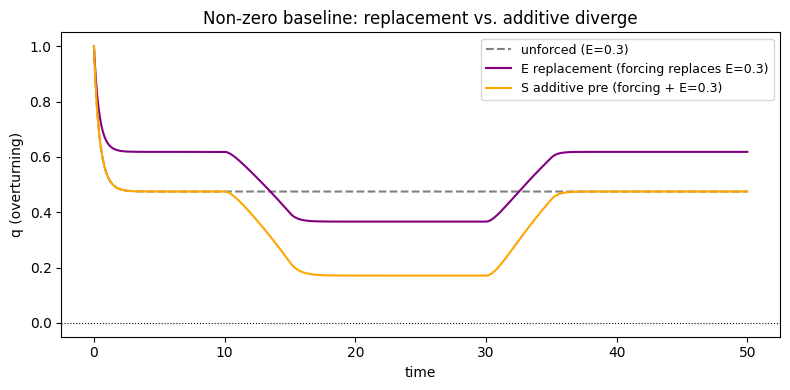
Figure. With \(E=0.3\) at construction, the two approaches diverge. E-replacement: the baseline \(E=0.3\) is completely overridden — during Hold periods E=0, so the effective freshwater input is zero. S-additive: the forcing adds on top of the existing \(E=0.3\) term in \(\dot{S}\), so the total freshwater influence is \(E + f(t)\). Choose the approach that matches the physical interpretation of your forcing.
Summary of the two approaches:
register_forcing('E', ...) |
register_forcing('S', ..., 'additive', timing='pre') |
|
|---|---|---|
| Acts on | parameter E in param_values |
state variable S via dS/dt |
With non-zero E |
replaces the baseline entirely | adds perturbation on top of baseline |
| Physical meaning | the forcing is the net freshwater flux | an additional flux injected into the salinity budget |
| With adaptive solver (RK45) | ✓ applied at every function evaluation | ✓ applied at every function evaluation |
Note on
timing='post': Registering a state-variable additive forcing withtiming='post'would add the forcing value directly toSafter each integration step (rather than todS/dt). This is not physically meaningful here and will generate a warning when used with adaptive solvers, which do not support post-step application.
Time-evolving parameters
Any parameter in param_values can be a callable instead of a scalar. The dispatcher accepts (t), (t, state), or (t, state, model). Here E drifts upward slowly without using a Forcing object:
def E_ramp(t):
    return np.clip(0.012 * t, 0.0, 0.6)

model_ramp = Stommel(E=E_ramp, T_star=1.0, S_star=0.0)
out_ramp = model_ramp.integrate(t_span=(0, 50), y0=[1.0, 0.0], method='RK45')

fig, axes = plt.subplots(2, 1, figsize=(8, 5), sharex=True)
axes[0].plot(out_ramp.time, out_ramp.diagnostic_variables['q'], color='purple')
axes[0].axhline(0, color='k', lw=0.8, ls='--'); axes[0].set_ylabel('q')
t_plot = np.linspace(0, 50, 500)
axes[1].plot(t_plot, [E_ramp(t) for t in t_plot], color='teal')
axes[1].set_ylabel('E(t)'); axes[1].set_xlabel('time')
plt.tight_layout(); plt.show()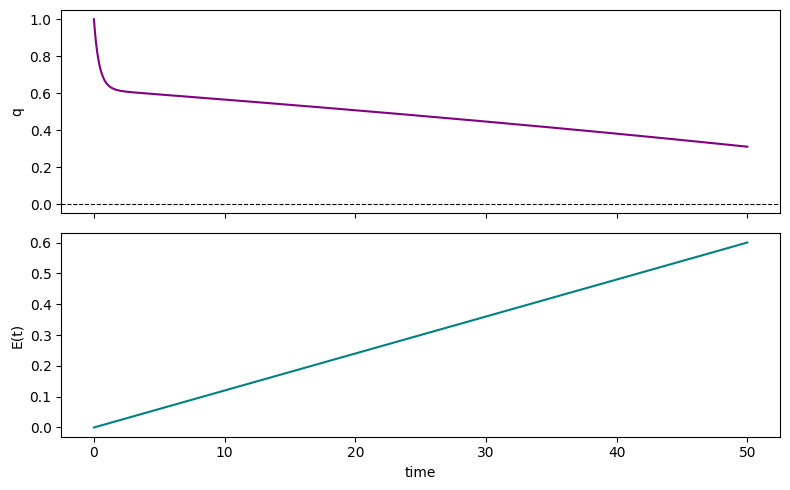
Figure. Top: overturning \(q\) under a linearly increasing \(E\) (freshwater input). \(q\) declines steadily and crosses zero around \(t \approx 35\) — the circulation collapses from thermally-direct (TH mode, \(q>0\)) to salinity-driven (SA mode, \(q<0\)). Bottom: the \(E(t)\) ramp used. This is the canonical Stommel bifurcation: once \(q<0\), the system is in a different stable state.
Converting to pyleoclim
ts_q = output.to_pyleo(var_names=['q'])
ts_q.plot()
plt.show()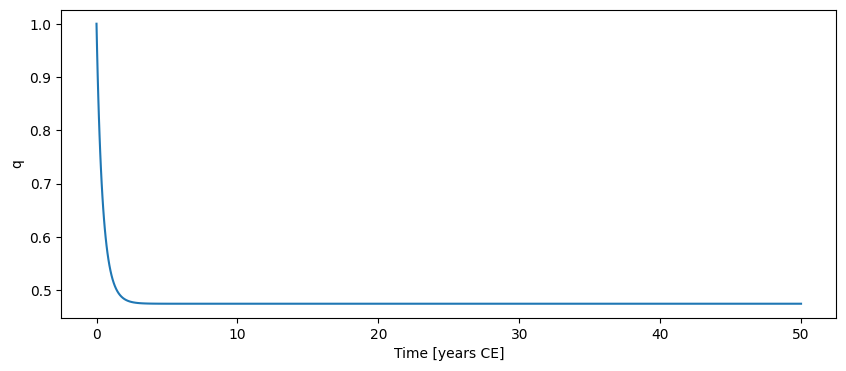
{}Solver notes
RK45 is appropriate for this model. Near an overturning collapse (where q passes through zero) the system can stiffen — tighten tolerances if trajectories look erratic:
output = model.integrate(
    t_span=(0, 50), y0=[1.0, 0.0], method='RK45',
    kwargs={'rtol': 1e-8, 'atol': 1e-10},
)
The diagnostic q is computed from the full trajectory after integration (uses_post_history = True) and is not available mid-run.