core.forcing.Ramp
core.forcing.Ramp(
    duration=None,
    y0=None,
    yf=None,
    A=None,
    y_exit=None,
    shape='linear',
    plot_kwargs=None,
)
Monotonic transition between two values with linear or cosine easing.
Parameters
duration : float = None-
Length of the transition.
y0 : float = None-
Starting value. If omitted, inherits from the previous segment’s endpoint.
yf : float = None-
Ending value. If omitted, computed from
Aory_exit. A : float = None-
Signed amplitude of the transition (
yf = y0 + A). Used whenyfis not specified directly. y_exit : float = None-
Absolute target value combined with
Aanddurationto compute a proportionally scaled duration. shape : ('linear', 'cosine') = 'linear'-
Interpolation shape.
'cosine'gives a smooth S-curve (eased start and end);'linear'is a straight line. Default'linear'.
Notes
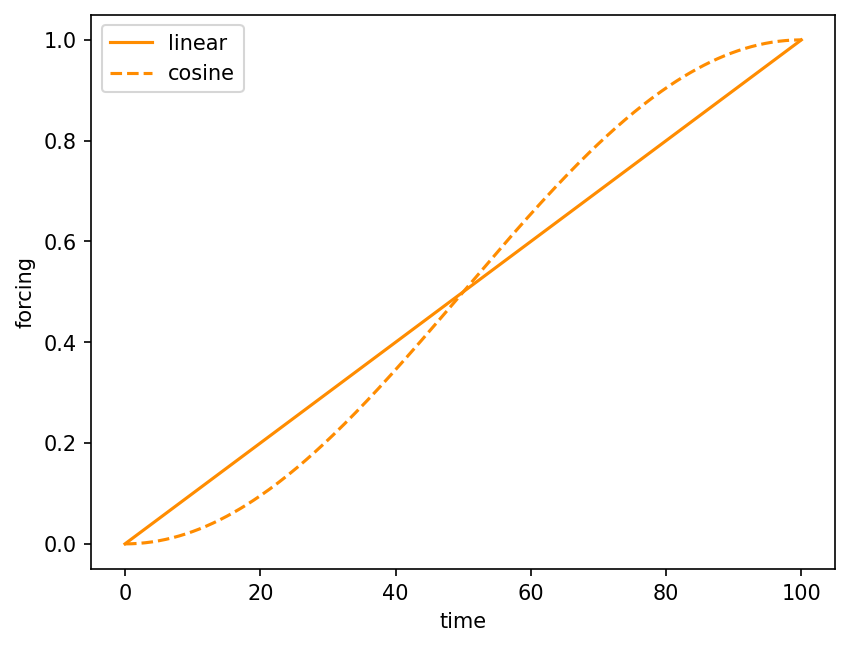
The shape='cosine' option applies a half-cosine ease, producing an S-curve::
y(τ) = y0 + (yf - y0) * 0.5 * (1 - cos(π * τ / duration))This is smoother than 'linear' at both endpoints and is a good choice when the transition is intended to represent a gradual forcing change rather than an abrupt one.
Examples
import matplotlib.pyplot as plt
import climatecritters as cc

fig, ax = plt.subplots()
cc.forcing.Ramp(100, y0=0.0, yf=1.0, shape='linear').plot(ax=ax, label='linear')
cc.forcing.Ramp(100, y0=0.0, yf=1.0, shape='cosine').plot(ax=ax, label='cosine', linestyle='--')
ax.legend()
plt.savefig('docs/reference/figures/Ramp_shapes_example.png',
            dpi=150, bbox_inches='tight')