core.Forcing
core.Forcing(
    data,
    time=None,
    params=None,
    interpolation='cubic',
    plot_kwargs=None,
)
Unified time-varying signal consumed by models.
Forcing wraps any time-dependent input and exposes a single get_forcing(t) interface to the model.
Input types
Pass a callable, a data array, a bundled CSV dataset, or a compiled ForcingSequence::
# callable
f = cc.Forcing(lambda t: 1360.0 + 5.0 * np.sin(2 * np.pi * t / 11.0))

# data array
f = cc.Forcing(data=values, time=t_axis, interpolation='cubic')

# bundled CSV dataset
f = cc.Forcing.from_csv(dataset='vieira_tsi')
f = cc.Forcing.from_csv(file_path='my_data.csv', time_name='age', value_name='co2')

# ForcingSequence (auto-compiled)
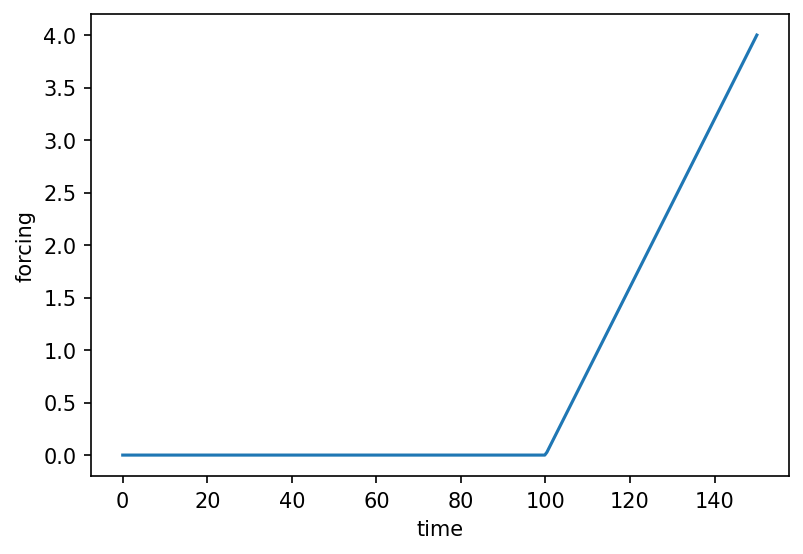
seq = cc.forcing.Hold(100, value=0.0) + cc.forcing.Ramp(50, y0=0.0, yf=4.0)
f   = cc.Forcing(seq)
Value superposition
Two Forcing objects (or a Forcing and a callable) can be combined with + to produce a new Forcing whose value is the pointwise sum::
combined = cc.Forcing(orbital_func) + cc.Forcing(noise_func)A bounded ForcingElement or ForcingSequence can also be superposed; it is auto-compiled and the result is bounded to that element’s duration.
Full operator table:
| Left | Right | Result | Semantic |
|---|---|---|---|
Forcing |
Forcing |
Forcing (indefinite) |
value superposition for all t |
Forcing |
callable | Forcing (indefinite) |
value superposition for all t |
ForcingElement |
ForcingElement |
ForcingSequence |
temporal concatenation |
ForcingSequence |
ForcingElement / ForcingSequence |
ForcingSequence |
temporal concatenation |
ForcingElement / ForcingSequence |
Forcing |
Forcing (bounded) |
additive overlay; auto-compiles |
Forcing |
ForcingElement / ForcingSequence |
Forcing (bounded) |
additive overlay; auto-compiles |
Parameters
data : callable, array-like, or ForcingSequence-
The signal source. See Input types above.
time : array -like= None-
Time axis for array-backed
Forcing. Must be strictly increasing and the same length asdata. If omitted, integer indices are used. params : dict = None-
Extra keyword arguments forwarded to a callable
dataviafunctools.partial. interpolation : ('cubic', 'linear') = 'cubic'-
Interpolation method for array-backed
Forcing. Default'cubic'. plot_kwargs : dict = None-
Matplotlib keyword arguments used by
.plot()— e.g.color,linewidth,label,linestyle. Explicit kwargs passed to.plot()override these defaults.
Examples
import matplotlib.pyplot as plt
import climatecritters as cc

scenario = (
    cc.forcing.Hold(200, value=280.0)
    + cc.forcing.Ramp(100, y0=280.0, yf=560.0, shape='cosine')
    + cc.forcing.Hold(200, value=560.0)
)
fig, ax = scenario.compile().plot()
plt.savefig('docs/reference/figures/Forcing_sequence_example.png',
            dpi=150, bbox_inches='tight')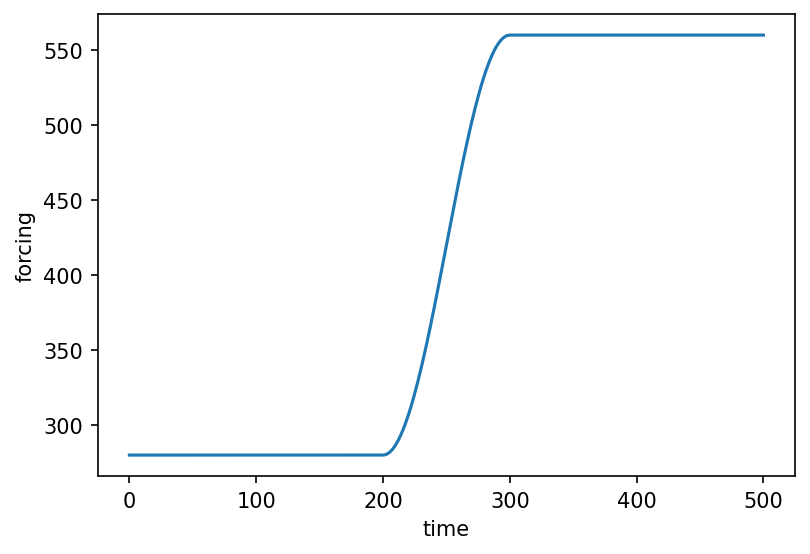
Methods
| Name | Description |
|---|---|
| from_csv | Build a Forcing from a CSV file or a bundled dataset. |
| from_sequence | Build a Forcing from an iterable of ForcingElement parts. |
| get_forcing | Return the forcing value at time t. |
| plot | Plot the forcing signal over a time range. |
from_csv
core.Forcing.from_csv(
    dataset=None,
    file_path=None,
    value_name=None,
    time_name=None,
    params=None,
    interpolation='cubic',
)
Build a Forcing from a CSV file or a bundled dataset.
Two datasets are included with ClimateCritters:
'vieira_tsi'— Vieira et al. total solar irradiance reconstruction'insolation'— 65°N summer solstice insolation (Laskar et al.)
Parameters
dataset : ('vieira_tsi', 'insolation') = 'vieira_tsi'-
Name of a bundled dataset. Mutually exclusive with
file_path. file_path : str or Path = None-
Path to an arbitrary CSV file. Mutually exclusive with
dataset. value_name : str = None-
Column name for the forcing values. If omitted, the first column (or the dataset default) is used.
time_name : str = None-
Column name for the time axis. If omitted, integer indices are used (or the dataset default is applied).
params : dict = None-
Extra keyword arguments forwarded to the interpolator.
interpolation : ('cubic', 'linear') = 'cubic'-
Interpolation method. Default
'cubic'.
Returns
forcing : Forcing
Examples
import climatecritters as cc

# Bundled dataset
tsi = cc.Forcing.from_csv(dataset='vieira_tsi')

# Custom CSV
co2 = cc.Forcing.from_csv(
    file_path='data/co2_record.csv',
    time_name='age_kyr',
    value_name='co2_ppm',
    interpolation='linear',
)
from_sequence
core.Forcing.from_sequence(parts, label='forcing')Build a Forcing from an iterable of ForcingElement parts.
Convenience alias for ForcingSequence(parts, label).compile().
Parameters
parts : iterable of ForcingElement-
Ordered
Hold,Ramp,Harmonic, or generalForcingElementinstances defining the piecewise timeline. label : str = 'forcing'-
Human-readable label for the resulting forcing object.
Returns
forcing : Forcing
Examples
import climatecritters as cc

f = cc.Forcing.from_sequence([
    cc.forcing.Hold(duration=100, value=0.0),
    cc.forcing.Ramp(duration=50, y0=0.0, yf=1.0, shape='cosine'),
    cc.forcing.Hold(duration=100, value=1.0),
], label='freshwater_hosing')
get_forcing
core.Forcing.get_forcing(t)Return the forcing value at time t.
Parameters
Returns
: float orndarray
plot
core.Forcing.plot(t_span=None, n=300, ax=None, **kwargs)Plot the forcing signal over a time range.
Parameters
t_span : (float, float) = None-
Time range
(t0, tf)to evaluate and plot. For sequence-backedForcingobjects this defaults to(0, summary["t_end"]). For array-backed objects it defaults to(time[0], time[-1]). For callable-backed objectst_spanis required. n : int = 300-
Number of evaluation points. Default 300.
ax :matplotlib.axes.Axes= None-
Axes to plot into. A new figure is created if
None. ****kwargs** : = {}-
Additional keyword arguments forwarded to
ax.plot(e.g.color,linewidth,label).
Returns
fig :matplotlib.figure.Figureax :matplotlib.axes.Axes
Raises
: ValueError-
If
t_spanis not provided for a callable-backedForcingthat has no time axis.
Examples
import numpy as np
import matplotlib.pyplot as plt
import climatecritters as cc

# Sequence-backed — t_span inferred automatically
f = cc.Forcing.from_sequence([
    cc.forcing.Hold(100, value=0.0),
    cc.forcing.Ramp(50, y0=0.0, yf=4.0),
])
fig, ax = f.plot()
plt.savefig('docs/reference/figures/Forcing_plot_example.png',
            dpi=150, bbox_inches='tight')

# Callable-backed — t_span required
solar = cc.Forcing(lambda t: 1360.0 + 5.0 * np.sin(t))
fig, ax = solar.plot(t_span=(0, 50))
plt.savefig('docs/reference/figures/Forcing_plot_callable_example.png',
            dpi=150, bbox_inches='tight')